
How to Set Up a Company in Turkey: What the Process Does Not Tell You
Setting up a company in Turkey is straightforward on paper. The process is documented, the steps are sequential, and the timeline is predictable. What is not predictable is what the structure you choose at registration will cost you two or three years later.
Foreign investors typically arrive at company formation with a clear objective: enter the market, establish a legal presence, and begin operations. The assumption is that incorporation is a procedural milestone. Complete the paperwork, open the account, and move forward. In most cases, that assumption holds until something changes: a shareholder relationship shifts, a new investor requires different terms, a regulatory licence reveals a structural incompatibility, or a dispute surfaces that the articles of association were never designed to resolve.
The registration process is visible and administrative. The structural consequences of the decisions made during that process are not. Capital distribution, governance authority, shareholder rights, and exit mechanisms are all determined at formation. They do not create friction immediately. They emerge over time, at exactly the moments when changing them is most difficult.
This guide covers how to set up a company in Turkey step by step. It also explains the decisions that determine whether that company functions without structural friction in the years that follow.
Can Foreigners Set Up a Company in Turkey?
Yes. Turkey allows 100% foreign ownership in most sectors. Under the Foreign Direct Investment Law, foreign investors have the same rights as domestic investors, with no requirement for a local partner and no residency requirement for shareholders.
From a legal entry perspective, Turkey is one of the more accessible jurisdictions for company formation. Accessibility, however, is a threshold condition. It determines whether you can enter. It does not determine whether the structure you enter with will function under pressure.
Choosing the Right Legal Structure
The first decision in company formation is the legal entity type. Turkey offers two primary structures for foreign investors.
Limited Liability Company (Ltd. Şti.)
The Ltd. Şti. requires a minimum capital of 10,000 TRY and accommodates between one and fifty shareholders. Management is handled by one or more managers rather than a formal board. It is the most commonly chosen structure by foreign investors entering Turkey for the first time.
Its advantages are practical: faster to establish, simpler to manage, lower administrative burden at the early stage. What it trades for that simplicity is structural flexibility at scale. Share transfers are restricted by law and require notarised approval from other shareholders. Capital increases follow defined procedures. The governance model is functional for small operations but creates friction when the company grows, when a new investor enters, or when a shareholder wants to exit.
Joint Stock Company (A.Ş.)
The A.Ş. requires a minimum capital of 50,000 TRY and is built around a mandatory board structure. Share transfers are unrestricted unless the articles specify otherwise. It is the required structure for certain regulated sectors, including finance, insurance, and specific energy licensing categories.
For companies that plan to raise capital, bring in institutional investors, pursue acquisitions, or operate in regulated industries, the A.Ş. provides the structural foundation those scenarios require. The administrative obligations are higher. The structural ceiling is correspondingly higher.
The Decision That Is Often Made Incorrectly
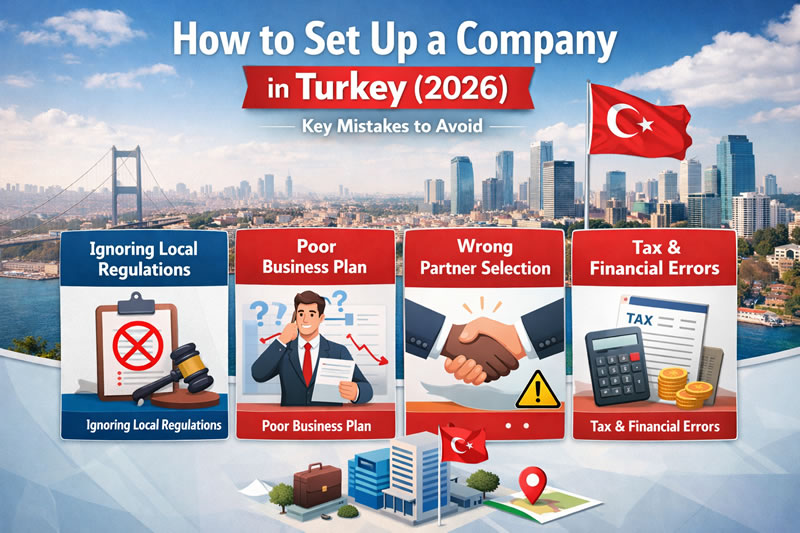
Most investors choose a legal entity based on how quickly it can be registered and how simple the initial setup appears. That logic is understandable. It is also the source of the most common structural problem in foreign-owned companies in Turkey.
Converting from an Ltd. Şti. to an A.Ş. is legally possible. It is not without cost, procedural complexity, or disruption to ongoing operations. The structure you choose at formation is not a starting point that can be adjusted easily. It is a framework that everything else is built on.
The question is not which structure is simpler to register. The question is which structure reflects how the company will actually operate, grow, and change hands over its lifetime.
Step-by-Step: How to Set Up a Company in Turkey
Step 1: Choose the Company Name
The name must be unique within Turkey’s Trade Registry system and compliant with Turkish Commercial Code naming rules. Certain terms require regulatory approval before they can be used. Name availability should be confirmed before proceeding with document preparation.
Step 2: Obtain Tax Identification Numbers
All foreign shareholders must obtain a Turkish tax identification number before the registration process can be completed. This applies regardless of whether the shareholder is an individual or a legal entity. Non-resident individuals can obtain a tax ID at a Turkish tax office without establishing residency.
Step 3: Prepare Articles of Association
The articles of association define the company’s ownership structure, capital distribution, management authority, and operational rules. Most standard templates cover the statutory minimums. What they do not cover is everything that becomes relevant when the relationship between shareholders becomes complicated.
Standard articles do not address how disputes between shareholders are resolved. They do not define what happens when a shareholder wants to exit and no buyer exists. They do not specify decision thresholds for major transactions, governance rights for minority shareholders, or mechanisms for resolving deadlocks.
When those situations arise, and in multi-shareholder companies they eventually do, the applicable rules are the default provisions of the Turkish Commercial Code. Not the rules you would have designed if you had considered those scenarios at the start. A well-drafted shareholder agreement in Turkey works alongside the articles to address what templates leave unresolved.
Step 4: Register Through MERSİS
The application is submitted through Turkey’s central Trade Registry system (MERSİS) and finalised at the relevant Trade Registry Office. Documents must be notarised. Foreign documents require apostille certification and sworn translation before submission.
Step 5: Tax Registration
Following Trade Registry approval, the company is registered with the local tax authority. This activates the company’s tax obligations. Accounting and VAT filings begin from registration, not from the date the company first generates revenue.
Step 6: Open a Corporate Bank Account
A corporate bank account is required for operational activity. Due diligence requirements vary between Turkish banks, and the process for foreign-owned companies typically takes longer than domestic incorporations. Some banks require physical presence; others accept power of attorney.
Capital Structure and the Governance Problems It Creates
Capital is not only a financial concept. In company law, it is the mechanism through which control is allocated.
A 50/50 ownership structure appears balanced. Legally, it is a deadlock structure. Not because the shareholders are likely to disagree, but because the structure provides no resolution mechanism when they do. Equal votes on every material decision means that any dispute between shareholders becomes a structural impasse. The company cannot act.
This is not an uncommon scenario. It is one of the most predictable structural problems in foreign-owned companies, and it is created at formation, not after. Ownership distributions, voting thresholds for specific decisions, and governance design all belong to the formation stage. Reconstructing them after the fact requires renegotiating relationships that may already be under strain. A thorough legal due diligence process in Turkey often surfaces these structural gaps before they become operational problems.
Licensing and Regulatory Constraints
Registration and authorisation to operate are not the same thing.
In sectors including finance, banking, insurance, energy, healthcare, and private education, a registered company exists legally but cannot conduct regulated activity without the relevant licence or permit. The licensing process is separate from the Trade Registry process, is administered by sector-specific regulatory bodies, and in some cases determines the legal structure the company must adopt before applying.
Formation and licensing are not sequential. They are parallel processes that need to be designed together. A company formed with the wrong legal structure cannot apply for certain licences. A company formed without considering licensing requirements may need to restructure before it can operate. That restructuring happens after the formation cost has been incurred, and it introduces delays that cannot be accelerated.
What Happens After Formation
A company incorporated in Turkey has immediate compliance obligations regardless of whether it has begun generating revenue.
Tax filings begin at registration. Monthly VAT declarations, quarterly provisional tax returns, and annual corporate tax filings are all mandatory from the date of incorporation. Accounting records must be maintained from day one. For companies with foreign shareholders or cross-border transactions, transfer pricing rules and international reporting obligations may apply from the outset.
These obligations do not pause while the company establishes operations. They run in parallel with everything else the company is doing.
What Sound Company Formation Looks Like
A company that is well-formed is not one that was registered quickly. It is one that reflects the real ownership intentions of its shareholders, anticipates the decisions that will need to be made as the company grows, and operates without structural friction when those moments arrive.
The decisions that matter most in company formation are made before anything is visible. Legal structure, capital distribution, governance design, articles of association, and regulatory positioning are all determined at a stage when the company does not yet exist and no immediate pressure reveals why they matter. That is precisely when they need the most attention.
Working with an investment lawyer in Turkey at the formation stage is not a procedural formality. It is the point at which structural decisions are made that the company will carry forward for its entire operational life. Most structural problems in foreign-owned companies in Turkey are not created by regulatory failure or market conditions. They are created at registration, by decisions that seemed minor at the time.
Frequently Asked Questions
How long does it take to set up a company in Turkey?
A standard Ltd. Şti. with straightforward documentation typically takes one to two weeks from submission to Trade Registry approval. Companies with multiple foreign shareholders, complex ownership structures, or apostille and translation requirements take longer. Delays are rarely procedural — they are almost always structural or documentation-related.
Can a foreign investor own 100% of a Turkish company?
Yes. Turkish law permits full foreign ownership in most sectors under the Foreign Direct Investment Law. There is no requirement for a Turkish partner or co-shareholder. Certain regulated sectors have specific ownership or licensing conditions that apply regardless of nationality.
Do I need to be physically present in Turkey to register a company?
No. The registration process can be completed through a notarised power of attorney granted to a representative in Turkey. The power of attorney itself must be apostilled and translated if executed outside Turkey. This is a standard procedure for non-resident foreign investors.
What is the minimum capital requirement?
The minimum capital for an Ltd. Şti. is 10,000 TRY. For an A.Ş., the minimum is 50,000 TRY. These figures reflect the statutory floor, not the practical capital needed to operate. Banks and licensing bodies may require evidence of substantially higher capitalisation depending on the sector.
Can I convert from an Ltd. Şti. to an A.Ş. later?
Yes. Conversion is legally possible under the Turkish Commercial Code. It involves a restructuring process that requires a general assembly resolution, notarised documentation, Trade Registry filings, and in some cases third-party approvals. It is not a simple administrative change, and it is considerably more disruptive than choosing the correct structure at the outset.
What taxes apply to a company in Turkey?
Corporate income tax is currently levied at 25% on net profits. VAT applies to most goods and services at rates of 1%, 10%, or 20% depending on the category. Withholding tax applies to dividend distributions and certain payments to non-residents. Companies must file monthly, quarterly, and annual tax returns from the date of registration.
What is a shareholder agreement and do I need one?
A shareholder agreement is a private contract between the company’s shareholders that governs their relationship beyond the articles of association. It can address exit rights, pre-emption rights, decision-making thresholds, non-compete obligations, and dispute resolution mechanisms. For multi-shareholder companies, it is not a legal requirement, but the absence of one is one of the most common sources of shareholder conflict in foreign-owned companies in Turkey.