
Inheritance runs through Turkish law as a structured system, not a natural right. The Civil Code defines who inherits, in what proportion, and under what conditions regardless of the deceased’s intentions, the family’s expectations, or the agreements made informally over the years. What the family understood to be settled is often, in legal terms, still open.
For foreign nationals and international families with assets in Turkey, this gap between expectation and legal reality is where most inheritance problems begin. The property is registered. The relationship is documented. But the legal process that follows death certificate of inheritance, tax clearance, title transfer, potential disputes over reserved portions moves on its own timeline, according to its own rules.
By the time a lawyer is consulted, some of that timeline has already passed. Deadlines accumulate quietly. The first step of the process determines how much of the next step is still available. To find a qualified inheritance lawyer in Istanbul before the process begins is to preserve options that, once the process starts without guidance, may no longer exist.
Turkish inheritance law covers a defined set of legal procedures: obtaining the certificate of inheritance (veraset ilamı), calculating and paying inheritance tax, transferring title to immovable property, and where necessary contesting a will or resolving disputes among heirs. Each step is sequential. Each has its own documentation requirements and its own deadlines. For international families, the process also involves coordinating across jurisdictions, translating and apostilling documents, and navigating reciprocity rules that govern foreign ownership of Turkish property.
Inheritance in Turkey is, in this sense, a predictable process with unpredictable consequences the legal steps are fixed, but the outcome depends entirely on how well the groundwork was laid before they began.
⚖️ How Turkish Inheritance Law Is Structured
Turkish inheritance law is governed by the Civil Code No. 4721. The structure is hierarchical: the law first recognizes statutory heirs descendants, surviving spouse, parents, siblings in a defined order. If a will exists, it operates within boundaries the law itself sets. Certain heirs cannot be fully disinherited. The reserved portion (saklı pay) guarantees a minimum share regardless of what the deceased intended.
This is where international families frequently encounter their first structural surprise. A will drafted in another jurisdiction, or even in Turkey without understanding reserved portion rules, may not distribute the estate as intended. The document exists. The intention was clear. But the legal outcome is different.
The reserved portion applies to descendants and, in some cases, to parents. A surviving spouse has inheritance rights regardless of the will. These are not procedural details they are substantive constraints built into the law, and they cannot be waived by agreement or circumvented by testamentary language alone.
🗂️ Certificate of Inheritance: The First Legal Step
Before any inherited asset in Turkey can be transferred, a certificate of inheritance (veraset ilamı) must be obtained. This document formally establishes who the heirs are and in what proportion each inherits. It is issued either by a notary public or by a civil court, depending on the circumstances.
For Turkish residents with straightforward family structures, the process is often administrative. For foreign nationals particularly where heirs are located in multiple countries, where documents need to be apostilled and translated, or where the family structure involves remarriage, adopted children, or foreign jurisdictions the process requires legal coordination that goes beyond paperwork.
The certificate is not the end of the process. It is the beginning. After the certificate, inheritance and gift tax must be assessed and paid at the relevant tax office. Only after tax clearance can the title deed to immovable property be transferred. Each step has its own requirements, its own timing, and its own points of failure.
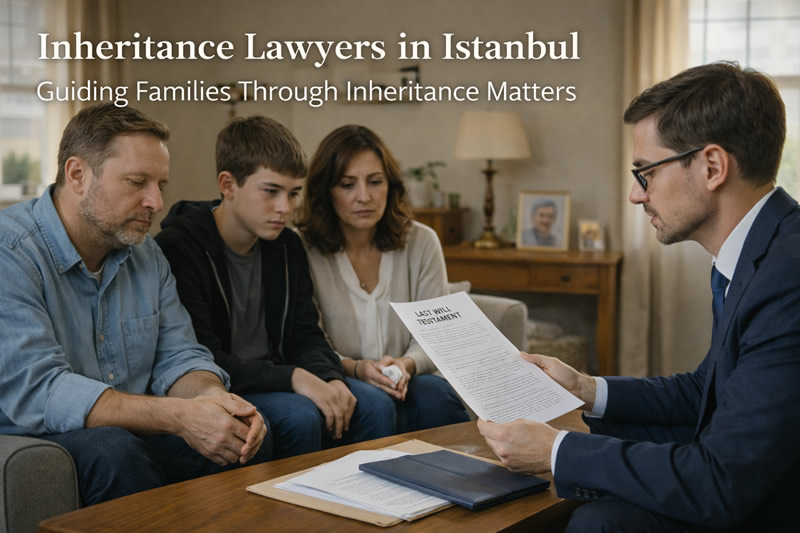
🏠 Immovable Property and Title Transfer
Real property in Turkey does not transfer automatically at death. The legal chain certificate of inheritance, tax assessment, title deed transaction at the land registry must be completed in sequence. Gaps in any link of that chain delay or block the transfer.
For foreign nationals inheriting Turkish property, additional layers apply. Reciprocity rules govern whether a foreign citizen can hold real estate in Turkey. Identification and documentation requirements differ from those applicable to Turkish citizens. The tax calculation depends on the value of the asset and the degree of kinship between the deceased and the heir and the applicable rates and exemption thresholds are updated annually.
An inheritance lawyer in Istanbul handles the coordination between these institutions: the notary, the tax office, the land registry, the court if required. The process is not conceptually complex, but it is procedurally dense. Each stage requires the previous one to be completed correctly.
For families managing broader asset and property structures in Turkey, see our page on wealth governance counsel.
📋 Wills in Turkish Law
A will in Turkey can take several forms: handwritten (holographic), official (notarial), or in certain circumstances, oral. Each form has validity requirements. A handwritten will must be entirely written, dated, and signed by hand typed wills are not valid. A notarial will is drafted before a notary with two witnesses present.
For international families, the question is often not whether a will exists, but whether it is valid under Turkish law and whether it can be enforced as intended. A will that is valid in the country where it was drafted may not produce the expected outcome in Turkey if it conflicts with reserved portion rules or does not meet Turkish formal requirements.
Turkish courts can also be asked to rule on the annulment of a will grounds include lack of testamentary capacity, undue influence, or formal defects. These proceedings are distinct from general inheritance disputes and require specific procedural handling.
🔍 Inheritance Disputes and Contested Estates
Not all inheritance matters are administrative. Disputes arise over the validity of a will, over the distribution among heirs, over assets that were transferred before death in ways that may now be subject to legal challenge, or over the interpretation of the certificate of inheritance itself.
When a dispute is likely or already active, the character of the legal work changes. An inheritance attorney in Istanbul operating in a contested matter needs not only knowledge of succession law but experience with civil litigation in Turkish courts. The timeline extends. The documentation requirements deepen. The strategic decisions made at the outset what to claim, when, and in which forum shape the outcome.
For a detailed treatment of disputed inheritance matters, see our page on inheritance dispute resolution.
👨👩👧 International Families and Cross-Border Succession
Succession becomes more complex when the deceased held assets in more than one country, when heirs are based across multiple jurisdictions, or when questions arise about which country’s law governs which part of the estate.
Turkey applies its own private international law rules to determine the applicable law in cross-border succession cases. The nationality of the deceased generally determines the applicable law for movable property; for immovable property, Turkish law applies to assets located in Turkey. These rules can produce unexpected results when family structures, asset locations, and nationalities do not align neatly.
For international families managing assets across jurisdictions, succession planning not just succession administration is the appropriate frame. What structures are in place before death determines how much friction the process carries after it.
For the broader legal framework governing family structures and asset arrangements in Turkey, our page on family law in Turkey addresses related considerations.
📌 Inheritance Tax in Turkey
Inheritance and gift tax is assessed on the value of assets transferred at death. The applicable rate depends on the declared value and the degree of kinship. Rates range from 1% to 30% for inheritance and are higher for gifts. Exemption thresholds are updated each year.
Tax is not automatically assessed it must be declared. The heirs are responsible for filing the declaration within the applicable period. Failure to declare, or late declaration, carries penalties. The tax office calculates the final amount based on the declared value; if the declared value is below the assessed market value, the office may revise it upward.
For assets of significant value particularly Istanbul real estate, which has appreciated substantially the tax assessment is a material consideration in the administration of the estate.
❓ Frequently Asked Questions
What is the first legal step after a death involving Turkish assets?
The first step is obtaining a certificate of inheritance (veraset ilamı) from a notary public or civil court. This document identifies the heirs and their respective shares and is required before any asset transfer can proceed.
Can a foreign national inherit property in Turkey?
Yes, subject to reciprocity rules. Citizens of most countries can inherit real estate in Turkey. The process requires additional documentation compared to Turkish nationals, including apostilled and translated documents from the heir’s home country.
What is the reserved portion and how does it affect a will?
The reserved portion (saklı pay) is a mandatory minimum share of the estate that certain statutory heirs primarily descendants and, in some cases, parents are entitled to regardless of the contents of a will. A will that attempts to exclude or reduce these shares below the statutory minimum can be challenged in court.
What is the inheritance tax rate in Turkey?
Rates vary depending on asset value and degree of kinship. For direct heirs (children, spouse), rates range from 1% to 10%. Exemption thresholds are adjusted annually. An inheritance lawyer can calculate the applicable tax based on the specific asset values and family structure.
Do I need a Turkish inheritance attorney if I am based abroad?
Yes. The process certificate of inheritance, tax declaration, title transfer, and any court proceedings takes place in Turkey and requires engagement with Turkish institutions. A local inheritance attorney coordinates these steps and can act under a power of attorney if the heirs cannot be present in person.
How long does the inheritance process take in Turkey?
Administrative cases without disputes can be completed in weeks to a few months. Cases involving contested wills, disputed distributions, or complex cross-border structures take significantly longer. The timeline depends on the completeness of documentation, the cooperation of all heirs, and whether court proceedings are required.
What happens if there is no will?
Without a will, the estate is distributed according to Turkish statutory succession rules. The Civil Code defines the order and proportion for each class of heirs. The surviving spouse inherits alongside children; if there are no children, the distribution shifts to parents and siblings.
Can a will made abroad be enforced in Turkey?
A foreign will can be recognized in Turkey if it meets the formal requirements of the country where it was made and does not violate Turkish public policy. However, reserved portion rules still apply. An inheritance lawyer should review any foreign will before assuming it will produce the intended result in Turkey.